
Journal article | Zeitschriftenartikel
Jugendliche ohne allgemeinbildenden Schulabschluß in Europa: regionale Disparitäten eines tabuisierten Problems
The consequences of dropping out of school without leaving qualifications for young peoples' career perspectives are severe. Wherever a meritocratic system and professionalisation of typical jobs mean that formal qualifications are decisive for an individual's career, the lack of a minimum school leaving qualification has extremely negative effects on further career possibilities. In order to examine this question on an European level, various countries with differing political structures and geographic locations, welfare state traditions and centralist-federalist organisation were selected: France as a centralist, western European country, Hungary as a formerly communist country, which started its process of transformation relatively early on, Sweden as the prototype of the Scandinavian welfare state and Germany as a federalist, western European country after reunification. There are large regional differences in the examined countries with regard to the "failure rate" in compulsory school education. In a national comparison, there are repeated patterns of regional inequality and comparable influential factors on regional inequality. These influential factors range from "individual" factors, such as sex, social origins and national/ethnic minorities, through to "structural" factors, such as the school system itself or the economic situation within the country. In addition to this, there may be synergy/ accumulative effects through a combination of individual and structural influential factors. Regional inequality with regard to the school success still exist in the examined countries. The influential factors are also subject to change. It remains true, however, that these problem groups -which have grown in Germany in the past few years- deserve more attention than they have received. The approaches to explaining regional inequality in the school system must also be reconsidered, as the regional di stributions of "winners" and "losers" is not complementary.

- Weitere Titel
-
Young Europeans without general secondary school leaving qualifications
- ISSN
-
0943-7142
- Umfang
-
Seite(n): 15-24
- Sprache
-
Deutsch
- Anmerkungen
-
Status: Veröffentlichungsversion; begutachtet
- Erschienen in
-
Europa Regional, 6.1998(1)
- Thema
-
Soziologie, Anthropologie
Städtebau, Raumplanung, Landschaftsgestaltung
Bildungs- und Erziehungssoziologie
Raumplanung und Regionalforschung
Europa
Bildung
Bildungsabschluss
Bildungsungleichheit
Schule
Schulabschluss
Jugendlicher
Bildungswesen
Soziologie
Ungleichheit
Schulversagen
Einfluss
Frankreich
Ungarn
Schweden
Bundesrepublik Deutschland
Geschlechterverteilung
- Ereignis
-
Geistige Schöpfung
- (wer)
-
Kramer, Caroline
- Ereignis
-
Veröffentlichung
- (wo)
-
Deutschland
- (wann)
-
1998
- URN
-
urn:nbn:de:0168-ssoar-48307-3
- Rechteinformation
-
GESIS - Leibniz-Institut für Sozialwissenschaften. Bibliothek Köln
- Letzte Aktualisierung
-
21.06.2024, 16:26 MESZ
Datenpartner
GESIS - Leibniz-Institut für Sozialwissenschaften. Bibliothek Köln. Bei Fragen zum Objekt wenden Sie sich bitte an den Datenpartner.
Objekttyp
- Zeitschriftenartikel
Beteiligte
- Kramer, Caroline
Entstanden
- 1998
Ähnliche Objekte (12)

Jugendliche ohne allgemeinbildenden Schulabschluß in Europa: regionale Disparitäten eines tabuisierten Problems
Abgänger aus allgemeinbildenden Schulen 2006
Abgänge aus allgemeinbildenden Schulen 2011: 5% ohne Hauptschulabschluss
Armut im Wohlstand: zunehmende soziale Disparitäten in Singapur
Zu den ethnischen Disparitäten in Makedonien während der Transformation
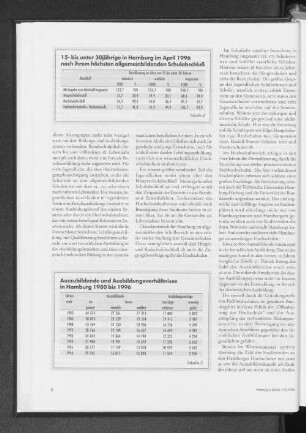
15- bis unter 30jährige in Hamburg im April 1996 nach ihrem höchsten allgemeinbildenden Schulabschluß
Bulgariens schwieriger Weg in die Europäische Union: ethnologische Perspektiven auf soziokulturelle Disparitäten

Zur voraussichtlichen Entwicklung der Schülerzahlen an allgemeinbildenden Schulen bis 2015: neue Modellrechnung für die Stadt- und Landkreise Baden-Württembergs
Ost-West-Disparitäten in Europa: Vergangenheit? An- und Einsichten anhand von ESPON-Projekten

Weniger Jugendliche ohne Schulabschluß aus integrierten Schulsystemen: Unterschiede im Schulerfolg nach Nationalität, Geschlecht und Region

Didaktik allgemeinbildenden Technikunterrichts
Didaktik allgemeinbildenden Technikunterrichts
Jugendliche ohne allgemeinbildenden Schulabschluß in Europa: regionale Disparitäten eines tabuisierten Problems
Abgänger aus allgemeinbildenden Schulen 2006
Abgänge aus allgemeinbildenden Schulen 2011: 5% ohne Hauptschulabschluss
Armut im Wohlstand: zunehmende soziale Disparitäten in Singapur
Zu den ethnischen Disparitäten in Makedonien während der Transformation
15- bis unter 30jährige in Hamburg im April 1996 nach ihrem höchsten allgemeinbildenden Schulabschluß
Bulgariens schwieriger Weg in die Europäische Union: ethnologische Perspektiven auf soziokulturelle Disparitäten
Zur voraussichtlichen Entwicklung der Schülerzahlen an allgemeinbildenden Schulen bis 2015: neue Modellrechnung für die Stadt- und Landkreise Baden-Württembergs
Ost-West-Disparitäten in Europa: Vergangenheit? An- und Einsichten anhand von ESPON-Projekten
Weniger Jugendliche ohne Schulabschluß aus integrierten Schulsystemen: Unterschiede im Schulerfolg nach Nationalität, Geschlecht und Region
Didaktik allgemeinbildenden Technikunterrichts
Didaktik allgemeinbildenden Technikunterrichts
Jugendliche ohne allgemeinbildenden Schulabschluß in Europa: regionale Disparitäten eines tabuisierten Problems
Abgänger aus allgemeinbildenden Schulen 2006
Abgänge aus allgemeinbildenden Schulen 2011: 5% ohne Hauptschulabschluss
Armut im Wohlstand: zunehmende soziale Disparitäten in Singapur
Zu den ethnischen Disparitäten in Makedonien während der Transformation
15- bis unter 30jährige in Hamburg im April 1996 nach ihrem höchsten allgemeinbildenden Schulabschluß
Bulgariens schwieriger Weg in die Europäische Union: ethnologische Perspektiven auf soziokulturelle Disparitäten
Zur voraussichtlichen Entwicklung der Schülerzahlen an allgemeinbildenden Schulen bis 2015: neue Modellrechnung für die Stadt- und Landkreise Baden-Württembergs
Ost-West-Disparitäten in Europa: Vergangenheit? An- und Einsichten anhand von ESPON-Projekten
Weniger Jugendliche ohne Schulabschluß aus integrierten Schulsystemen: Unterschiede im Schulerfolg nach Nationalität, Geschlecht und Region
Didaktik allgemeinbildenden Technikunterrichts