
Contributing to the cultural ecosystem services and human wellbeing debate: a case study application on indicators and linkages
Abstract: Inadequacies in the indication of cultural ecosystem services (CES) are a hindrance in assessing their comprehensive impacts on human wellbeing. Similarly, uncertainties about the quantity and quality of CES, in real time and space, have hampered the ability of resource managers to precisely take responsive management actions. The aim of the study is to demonstrate, how CES indicators can be identified and qualified in order to link CES to human wellbeing, and to integrate them into the ‘ecosystem services cascade’ and the Driver-Pressure-State-Impact-Response (DPSIR) models. A case study methodology is applied at the Nairobi-Kiambu (Kenya) peri-urban area. Primary data on CES was collected in the case study through survey, field observations and matrix tables. Secondary data originates from literature analysis. Results show that the participatory identification of CES and human wellbeing indicators could improve their transparency and comprehensibility. The environmental polic.... https://www.landscape-online.org/index.php/lo/article/view/30
- Location
-
Deutsche Nationalbibliothek Frankfurt am Main
- Extent
-
Online-Ressource
- Language
-
Englisch
- Bibliographic citation
-
Contributing to the cultural ecosystem services and human wellbeing debate: a case study application on indicators and linkages ; volume:50 ; day:29 ; month:03 ; year:2017
Landscape online ; 50 (29.03.2017)
- Creator
-
Wangai, Peter Waweru
Burkhard, Benjamin
Kruse, Marion
Müller, Felix
- DOI
-
10.3097/LO.201750
- URN
-
urn:nbn:de:101:1-2020060816182297558236
- Rights
-
Open Access; Der Zugriff auf das Objekt ist unbeschränkt möglich.
- Last update
- 14.08.2025, 10:54 AM CEST
Data provider
Deutsche Nationalbibliothek. If you have any questions about the object, please contact the data provider.
Associated
- Wangai, Peter Waweru
- Burkhard, Benjamin
- Kruse, Marion
- Müller, Felix
Other Objects (12)

Müller, Felix
Müller, Felix
Gesuch des Felix Müller von Ertingen um Auswanderung nach Bayern
Beitrag zur Optimierung der Instandhaltung von elektromotorisch fahrbaren Flurförderzeugen mit Diskussion des ökonomischen Effekts

Über mathematische Inkunabeln

Zur Erinnerung an Hermann Grafsmann
Warum München rosa regiert wird : Die einzige schwul-lesbische Wählerinitiative in einem deutschen Stadtrat wurde vor 20 Jahren gegründet
[3 + 2]-Cycloadditionen von Azirin-Radikalkationen durch photoinduzierten Elektronentransfer
Die Floßfahrt auf der Iller und der Donau
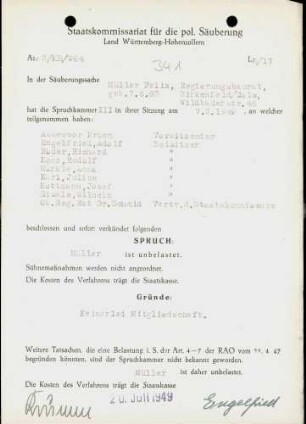
Müller
Müller, Felix
Müller, Felix
Müller, Felix
Müller, Felix
Gesuch des Felix Müller von Ertingen um Auswanderung nach Bayern
Beitrag zur Optimierung der Instandhaltung von elektromotorisch fahrbaren Flurförderzeugen mit Diskussion des ökonomischen Effekts
Über mathematische Inkunabeln
Zur Erinnerung an Hermann Grafsmann
Warum München rosa regiert wird : Die einzige schwul-lesbische Wählerinitiative in einem deutschen Stadtrat wurde vor 20 Jahren gegründet
[3 + 2]-Cycloadditionen von Azirin-Radikalkationen durch photoinduzierten Elektronentransfer
Die Floßfahrt auf der Iller und der Donau
Müller
Müller, Felix
Müller, Felix
Müller, Felix
Müller, Felix
Gesuch des Felix Müller von Ertingen um Auswanderung nach Bayern
Beitrag zur Optimierung der Instandhaltung von elektromotorisch fahrbaren Flurförderzeugen mit Diskussion des ökonomischen Effekts
Über mathematische Inkunabeln
Zur Erinnerung an Hermann Grafsmann
Warum München rosa regiert wird : Die einzige schwul-lesbische Wählerinitiative in einem deutschen Stadtrat wurde vor 20 Jahren gegründet
[3 + 2]-Cycloadditionen von Azirin-Radikalkationen durch photoinduzierten Elektronentransfer
Die Floßfahrt auf der Iller und der Donau
Müller
Müller, Felix