
Bewegte Bilder
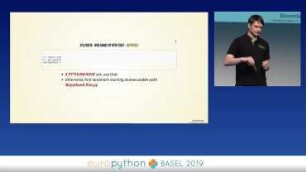
status quo of virtual environments: Learn what's the difference between venv and virtualenv
Python is easy to learn and use programming language; however, managing dependencies and package versions for it are nowhere as pleasant. One of the basic building block created to help with this is virtual environments. Join me in understanding how virtual environments work from within (by one of the project maintainers); also, to find out if the good old virtualenv project has any place left, now that Python 3.4+ contains venv. This talk is aimed to be a bit more technical in its first parts, presenting in technical details what a virtualenv is. The target audience is anyone who used virtual environments and wants to understand how they tick from within. I’ll also emphasise diversity and inclusion at Python interpreter level by highlighting other interpreters than CPython: Jython, PyPy or Iron Python. A concise outline goes as follows: What is a virtual environment? - why we need it - what we use it for - demo - virtualenv vs system env How do we build a virtual environment (CPython) - technical workflow of venv creation - activation -- bash -- powershell -- cmd.bat Other interpreters - why other than CPython? - PyPy - Jython - virtualenv - all Python support - extra activation - xonosh Summary and q/a
- Standort
-
Hannover TIB
- Umfang
-
139MB, 00:29:55:07 (unknown)
- Sprache
-
Englisch
- Anmerkungen
-
Audiovisuelles Material
- Erschienen in
-
EuroPython 2019 ; (Jan. 2019)
- Schlagwort
-
Virtual Env
- Ereignis
-
Veröffentlichung
- (wer)
-
EuroPython
- (wann)
-
2019-01-01
- Beteiligte Personen und Organisationen
-
Gabor, Bernat
- DOI
-
10.5446/44764
- Letzte Aktualisierung
- 21.04.2026, 10:49 MESZ
Datenpartner
Dieses Objekt wird bereitgestellt von:
Technische Informationsbibliothek (TIB).
Bei Fragen zum Objekt wenden Sie sich bitte an den Datenpartner.
Objekttyp
- zweidimensionales bewegtes Bild
Beteiligte
- Gabor, Bernat
- EuroPython
Entstanden
- 2019-01-01
Ähnliche Objekte (12)
status quo of virtual environments: Learn what's the difference between venv and virtualenv

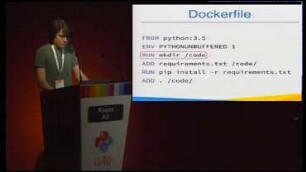
Real virtual environments without virtualenv
Real virtual environments without virtualenv

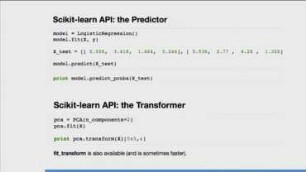
Scikit-learn to "learn them all"
Scikit-learn to "learn them all"
Learn Python The Fun Way

Learn Python The Fun Way
What can python learn from Haskell?

What can python learn from Haskell?

Extending Scikit-Learn with your own Regressor
Extending Scikit-Learn with your own Regressor

What Python can learn from Haskell packaging
status quo of virtual environments: Learn what's the difference between venv and virtualenv
Real virtual environments without virtualenv
Real virtual environments without virtualenv
Scikit-learn to "learn them all"
Scikit-learn to "learn them all"
Learn Python The Fun Way
Learn Python The Fun Way
What can python learn from Haskell?
What can python learn from Haskell?
Extending Scikit-Learn with your own Regressor
Extending Scikit-Learn with your own Regressor
What Python can learn from Haskell packaging
status quo of virtual environments: Learn what's the difference between venv and virtualenv
Real virtual environments without virtualenv
Real virtual environments without virtualenv
Scikit-learn to "learn them all"
Scikit-learn to "learn them all"
Learn Python The Fun Way
Learn Python The Fun Way
What can python learn from Haskell?
What can python learn from Haskell?
Extending Scikit-Learn with your own Regressor
Extending Scikit-Learn with your own Regressor